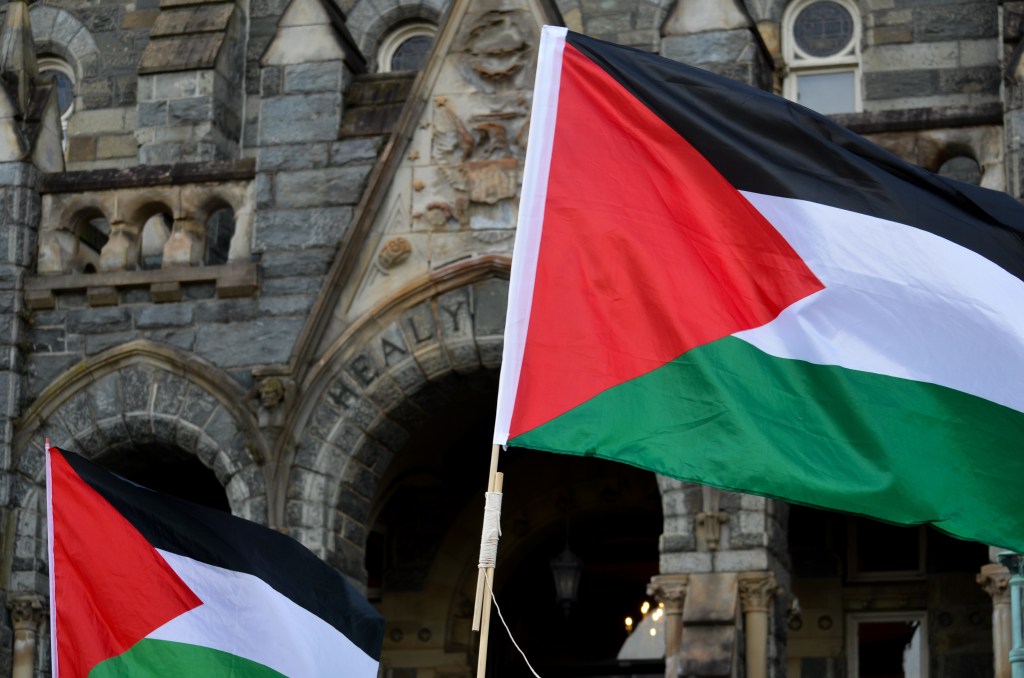
Letter to Georgetown University Administration: AAUP and MESA Report on Weaponization of Antisemitism
February 19, 2026
We write to bring your attention to an important report on the weaponization of charges of antisemitism recently published by the AAUP and Middle East Studies Association. We are colleagues raised to believe that antisemitism has played an especially pernicious role in modern history, with uniquely devastating results. We believe that anti-Jewish hatred has no place at Georgetown.
Real antisemitism is a serious moral violation; on that we can all agree. Because of this, we have been alarmed at some of the spurious ways in which accusations of antisemitism have been wielded in recent years. By this, we refer to how some raise the charge of antisemitism not to combat discrimination against Jews but rather to silence reasonable criticism of Israel. Indeed, in our professional lives, we have personally witnessed dozens of cases in which students and faculty were accused of antisemitic speech not because of anything they have said about Jews, Judaism, or Jewishness, but because they have expressed criticism of the policies and actions of the state of Israel.
These attacks on free speech succeed in part due to a misapprehension of history and facts. Many Americans have been taught to believe that support for the Jewish state—i.e., Zionism—is an inalienable component of Jewishness and Judaism, even though this is not true. It is an affront to conflate Zionism with Judaism and Jewishness: the former is a particular modern political ideology attached to an existing state with a controversial history; the latter are diverse and ancient and pluralistic. Not all Jews are Zionists, nor does Israel represent all Jews. Indeed, since 1948, most of the world’s Jews have chosen not to live in Israel. Today, many younger American Jews reject the idea that Israel represents them in any way. In short, it is incorrect to say that there is a consensus among the American Jewish community about Israel’s policies and actions, or even its right to exist in historic Palestine.
These attacks also succeed because of bad faith. Even as Jewish American communities grapple sincerely with their relationship to Zionism and Israel, there are powerful legacy organizations in this country, such as the American Jewish Committee (AJC) and the Anti-Defamation League (ADL), who have doubled down on the insistence that Israel represents Jewishness and Judaism, and who employ defamatory charges of antisemitism to attack those who question this equation. Under this pressure, many organizations have embraced the IHRA definition which explicitly conflates advocacy of Palestinian rights with antisemitism. For many years these organizations and their allies—such as the Israel-based Canary Mission or the Israeli lobby group AIPAC—have created media networks that slander critics of Israel with the goal of intimidating students and scholars from speaking out. Many within the Georgetown community have been injured by these attacks.
Fortunately, thanks to the wisdom and perspicacity of our leadership, Georgetown has weathered such attacks better than many of our peers. We have a number of administrators who have worked to protect the intellectual integrity of our campus, and this has allowed courses, public lectures, protests, and activities to take place. This deserves our support and applause. In most cases, our university has also ensured freedom of speech for students, staff, and faculty. Even so, we have seen how specious charges of antisemitism have been weaponized within our community. To take two recent examples:
- In Spring 2025, the Committee on Investments and Social Responsibility (CISR) rejected out of hand a proposal for ethical investing that included divestment from arms sales to Israel. Given Georgetown’s commitments to Jesuit values, and in light of the ongoing genocide in Gaza, this proposal should have been taken seriously. However, during its deliberations, CISR was effectively lobbied by members of The Committee for the Integrity of Academic Institutions as Centers of Learning, a previously unknown group composed solely of faculty dedicated to shielding the state of Israel from public criticism. Far from being a grassroots local effort, this committee was the invention of two well-funded pro-Israel lobby groups, The Faculty Against Antisemitism Movement, and Academic Engagement Network. These groups, which lobby campuses on a national level, routinely assert that divestment efforts that touch upon Israel in any way are ipso facto antisemitic. That reasoning seems to have won the day with Georgetown decision makers. Thus, questions about the ethics of university investments in weapons manufacturing globally were conflated with criticism of Israel specifically, which was in turn conflated with antisemitism.
- In the Summer of 2025, a student alleged that an instructor had made antisemitic comments. As it turns out, the core of the complaint had to do with criticism of Israel. Nonetheless, the instructor was terminated.
We send you this report and urge you to read it because it shows that such incidents are not isolated. The report focuses on the way Title VI of the Civil Rights Act has been used to weaponize claims of antisemitism which has had the result of relegating other forms of discrimination to the sidelines. Until now, Georgetown leadership has protected freedom of speech and inquiry as a core tenet of university life, Jesuit values, and American law, but the pressure campaigns are likely to increase. Unless we educate ourselves, we will be unable to protect our campus from internal and external attacks.
To conclude, we reiterate: Zionism and Israel do not represent the rich diversity of Judaism and Jewishness. Israel is a state. Just as support for that state is protected political speech, so is criticism. Thank you in advance for taking the time to read this important AAUP/MESA report and for continuing to work to protect the intellectual integrity of our campus.
On Behalf of AAUP Georgetown and the Georgetown University Faculty and Staff for Justice in Palestine.
On Georgetown and
Genocide in Gaza
September 2025
This petition calls on the Georgetown University administration to take a public position on the genocide taking place in Gaza. For the full text of the petition, see below.
If you are affiliated with Georgetown University but cannot access your GU email, please send an email to georgetownfsjp@gmail.com with your name, affiliation, and any other information you want to share.
Signatures are still being collected: Here is the link to sign the petition.
Dear Interim President Groves, Interim Provost Colbert, and the GU Board of Directors,
The Gaza ghetto is being liquidated.
As members of Georgetown University, we are deeply shaken, angered, and outraged by the carnage we have witnessed over the past 23 months.
Today, there is near global consensus that the government of Israel is guilty of the crime of genocide in Gaza, replete with mass starvation, the destruction of homes, hospitals, universities, schools, mosques, churches, cemeteries and—critically—the mass killing of innocent Palestinian
children. According to UNICEF, “over 18,000 children have been killed in Gaza since the beginning of the war. That’s an average of 28 children a day, the size of a classroom, gone.”
On August 31, 2025, the International Association of Genocide Scholars (IAGS) passed a resolution (by 86% of those voting) stating that “the government of Israel has engaged in systematic and widespread crimes against humanity, war crimes and genocide, including indiscriminate and deliberate attacks against the civilians and civilian infrastructure (hospitals,
homes, commercial buildings, etc.) of Gaza […].” This vote echoes similar findings in reports issued by Amnesty International, Human Rights Watch, the United Nations, B’Tselem, Physicians for Human Rights-Israel, al-Haq, and the Palestinian Center for Human Rights, among many other organizations.
As Israel’s largest military and diplomatic supporter, the U.S. government is deeply complicit in the killing. American-made weapons meant for battle against large standing armies are responsible for the destruction of Gaza, which now resembles Hiroshima after 1945.
Israeli Prime Minister Benjamin Netanyahu, indicted as a war criminal for his actions in Gaza, was invited to speak at a joint session of Congress in 2024 in the midst of the genocide. Despite the appalling crimes committed daily, Netanyahu received sixty-one standing ovations from American legislators, and also met with the President and Vice-President. In 2025, Netanyahu visited the White House again on three separate occasions.
As we watch this moral obscenity continue, we must ask: how do Georgetown’s Jesuit values compel us to act in the face of genocide? What is our university’s collective moral responsibility toward what Human Rights Watch has called “the crime against humanity of extermination.” Does “never again” also apply to the people of Gaza?
Just as we are, the late Pope Francis was deeply shaken by the genocide in Gaza. Every night, he bore witness by calling the beleaguered Palestinian Christian community in Gaza to offer his succor and support. He recognized and took a stand on the genocide in Gaza as the great moral issue of the 21st century. More recently, Pope Leo has said: “I am following with deep concern
the extremely grave humanitarian situation in Gaza, where the civilian population is being crushed by hunger and continues to be exposed to violence and death.” Pope Leo subsequently called for an immediate end to the “collective punishment” in Gaza.
Our campus honors the heroic efforts of Jan Karski (GU Alum and Professor) to alert the Allied powers to the genocide of Jews he witnessed during World War II in his native Poland. We honor him for speaking out to try to prevent the terrible evils of the Holocaust. Just this May, Georgetown’s Philodemic Society decided to add his portrait to the Philodemic Room in Healy
Hall. His statue graces our campus as a reminder of the necessity of bearing witness and following one’s conscience despite dangers. In his 1995 testimony to the University of Southern California Shoah Foundation, Karski said “God gave us a soul. Call it consciousness, whatever it is. And we have infinite capacity to do good, and every one of us has infinite capacity to do evil. And we have a choice—one or another…Everything is possible as a result.”
How will Georgetown University choose to respond to this genocide in our times?
Will you, Interim President Groves, lead the university to stand on the right side of history, or bring shame to Georgetown’s name by staying silent while Gaza is obliterated?
We respectfully demand that you immediately organize a town hall to discuss how Georgetown University will respond to this ongoing genocide.
Sincerely,
Undersigned Members of the Georgetown Community
Judith Tucker, Faculty, History
Aya Aymad, Student, STIA
Sarah McNamer, Faculty, English
Yassine Florez, Student, MAAS ’26
Onais Tariq, Student, GUMC graduate school
Anna Broderick, Student, Undergraduate SFS 2026
Anonymous, Faculty, McCourt School of Public Policy
Idun Hauge, Faculty, Center for Contemporary Arab Studies
Erica Lally, Alumni; Faculty, History PhD, 2025
Caleb Johnston, Student, MA in American Government
Theodora Danylevich, Faculty, MA ’08, English & Women’s & Gender Studies
Lois Wessel, Alumni; Staff, MA from NHS ’96, Associate Professor BSON/SOM
Eshal zahra, Student, Msb 2028
Nuh Cheema, Student, SOH ’29
Chloe Daikh, Student, Arab Studies
Shehryar, Student, CAS ‘2029
Rochelle Davis, Faculty, SFS
Mark Lance, Faculty, Emeritus Professor of philosophy
Anonymous, Student, Arab studies 2026
Maryam Arastu, Student, CAS ’26
Elliott Colla, Faculty, Arabic and Islamic Studies
C. Christine Fair, Faculty, SFS
Nader Hashemi, Faculty, SFS
Lauren Burns, Student, MAAS ’26
Fida Adely, Faculty, SFS
Yusuf Qavi, Student, BGE
Crystal Luo, Faculty, History/American Studies
Jackson Schnabel, Student, SFS ’27
Melinda González, Faculty, School of Foreign Service
Liz Walker, Student, MA Arab Studies 2026
Josh Ruebner, Faculty, Justice and Peace Studies, Adjunct Lecturer
Hasan Jashari, Student, MSFS ’26
Ethan Weisbaum, Student, History PhD, 2029
Aminah Yusuf, Alumni, SFS ‘2024
Ulla Ali, Student, Arab Studies
Juliette Warga, Student, CAS ’26
Camille Kelly, Student, C’26
Sumayah Oudda, Student, Georgetown University School of Medicine M’28
Hafsa Kanjwal, Alumni, SFS 2008
Laurie King, Faculty, Anthropology
Anonymous, Student; Staff, English
Farah El-Sharif, Alumni, BSFS
Khadeeja Arastu, Student, Arabic & Computer Science C’28
Mimi Kirk, Staff, Associate Director, CCAS
Anonymous, Student, CAS 26
Yusra Rafeezi, Student, School of Medicine
Raffaele Sherman, Student, MSFS 26
Amanda Phillips, Faculty, Associate Professor of English
Ansley Markwell, Alumni; Staff, GSAS ’23
Manu Chandler, Faculty, English
Anonymous, Staff; Faculty, English
Ian DeHaven, Student, MAAS ’26
Jonathan Stupple, Staff, Director of Programs, ACMCU, SFS
Judy Blancaflor, Student, MSFS
Sarah Kureshi, Faculty, Family Medicine
Lidya Woldeyesus, Student, Urban and Regional Planning MPS’26
Anonymous, Student, M28
Tom Sullivan, Alumni, Bachelor of Arts in Liberal Studies, SCS’17
Nick Ragde, Student, C’25 (undergrad) and GSAS ’26
Malek Zanbrakji, Student, H’28
Layal Suboh, Student, School of Medicine
Mary Tezak, Student, History PhD
Mohammed Usrof, Alumni, SFS’2025
Suzanne P. Stetkevych, Faculty, Arabic & Islamic Studies, Emerita
Greg Afinogenov, Faculty, Associate Professor, History
Wade McMullen, Distinguished Fellow, Human Rights Institute, GU Law Center
Zaid Abuhamda, Student, Government, CAS ’26
Sam Halabi, Faculty, Health Management and Policy
Ellen Gorman, Faculty, English
Lahra Smith, Faculty, African Studies (SFS) and Government Dept
Abdus Samad Pardesi, Alumni, College ’06
Anonymous, Student, Arabic and Islamic Studies
M. Saad Yacoob, Student, Arabic and Islamic Studies, PhD, 2026
Gabriela Saba, Student, CCAS MAAS
Nefertiti Takla, Faculty, History
Jeremy Suzuku, Student, SFS ’28
Amani Morrison, Faculty, English, Assistant Professor
Joan Mandell, Faculty, Adjunct Lecturer, SFS/CCAS
Rose Dallimore, Alumni; Staff, SFS ’22
Juan Ramirez, Student, History, PhD Student
Meriam Ahmad, Student, SFS ’26
Ala, Staff, University Services/ Main Campus Accounting Manager
Anonymous, Student, C’28
Nimrah Karim, Alumni, College ’07
Mobashra Tazamal, Staff, The Bridge Initiative, Associate Director
Hania Qutub, Faculty, Medicine
Yazan Alhamdan, Student, IPOL SFS
Noor Zaareir, Student, Human Science Undergraduate
Benjamin Jones, Student, History PhD
Jonathan Mendoza, Dept. of Government – MA Democracy & Governance, ‘26
Maeesha Noshin, Student, School of Medicine
Anonymous, Student, MD 2028
Anonymous, Student, Medical School
Mike Naughton, Student, M’27
Benan Grams, Alumni, MAAS 2014, History 2022
Riad Alarian, Student, Arabic and Islamic Studies, PhD student
Leena Kethu, Student, GSAS department of epidemiology
William Freericks, Student, College of Arts and Sciences 2029
Anonymous, Student, M.A./International Migration and Refugee Studies C’25
Izzy Volpe, Student, SFS ’27
Sophia Chaudri, Student, College of Arts & Sciences ‘27
Anonymous, Student; Alumni, CAS’24, L’28
Lily, Student, Government C’29
Daliya Saadoon, Student, Law 2027
Ceyla Karabulut, Student, SFS 29
Zara Hai, Student, SFS ’29
Raha Murtuza, Student, SFS ’28
Aisha Nefise Bazlamatci, Student, Masters of Physiology and Biophysics
Ava Zabelski, Student, SFS ’26
Ariel Kline, Faculty, Art and Art History
Haley Jaworski, Student, Undergraduate Student, CAS 2027
Julia Rasmussen, Student, SFS ’27
Nadia Chaudhiri, Alumni, College ’01
Anonymous, Student, Arab Studies
Miya Yoshida, Student, SFS ’28
Brigid O’Connor, Student, Justice and Peace Studies ’26
Kai Khaund, Student, SFS ’28
Anonymous, Student, SFS ’26
Soumya Bodhanapu, Student, SFS ’29
Nola Millet, Student, CAS 26
Justin Liu, Student, BA ’24, JD ‘28, MPP ‘28
Andria Wisler, Staff; Faculty
Wassan Abdelkarim, Student, CAS ’28
Pia Cruz, Student, Anthropology C’27
Sreya Patri, Student, SFS ’26
Anonymous, Student, C ’26
Faith Specter, Student, SFS ’26
Evan Ecklund, Student, CAS ’26
Natalie Gustin, Student, SFS ’26
Cal Ricehall, Student, Government & History, CAS ‘27
Lucia Zambetti, Student, CAS ’26
Anonymous, Student, SFS ’28
Elizabeth, Faculty, ITL
Fiona, Alumni, SFS ’26
Howard R. Spendelow, Emeritus Faculty, History
Norman Francis Jr., Student; Alumni; Staff, C’20, L’28
Thomas Santos Emch, Student, SFS ’27
Yeabsera Fitsum, Student, CAS ’26
Zayne Nemry, Student, SFS ’27
Anonymous, Staff, Office of Advancement
Madison Allen, Alumni, CAS ’25
Anonymous, Faculty, SFS
Mohammad Fakhreddine, Faculty, Arabic and Islamic Studies
Anonymous, Student, PhD Arabic and Islamic Studies
Jeff Popovich, Alumni; Staff, Liberal Studies BA 92, Masters English 95
Anonymous, Staff, Librarian, Georgetown University Library
Finley Heesch, Student, CAS ’27
Van Tran Nguyen, Faculty, Dept. Performing Arts
Felicitas Opwis, Faculty, Arabic and Islamic Studies
Sophia Comiskey, Student, SFS ’26
Amy Lin-Truong, Student, MPM ’26
Olivia Pozen, Student, CAS ’26
Samar Saeed, Student, History 2026
Grace Copps, Student, CAS ’26
Steve Keller, Alumni, MAAS 2000
Susan Baker, Alumni, SFS 1991
Laila Al-Arian, Alumni, College ’03
Sarah Capper, Alumni, MAAS ’06
Noor Al Shaikh, Alumni, MAAS 2023
Amy Leonard, Faculty, Associate Professor of History
Kathryn de Luna, Faculty, History
Kwame Otu, Faculty, SFS
Rahma Abdallah, Student, SOH ’27
Khaled Elgindy, Faculty, Adjunct Professor, CCAS
Melanie White, Faculty, Black Studies & Women’s & Gender Studies
Maurice Jackson, Faculty, Grad 1995, PhD, 2001
Isabella Sicilian, Student, CAS 26
Jacob Gardner, Student, Public Policy CAS’29
Vienna Cheshire, Alumni, C’25
Rajesh Veeraraghavan, Faculty, SFS
Christine Evans, Faculty, Professor, Department of Performing Arts
Max Dubin, Student, Philosophy 27
Hank Pin, Alumni, Arab Studies 2016
Donia Khraishi, Alumni, Masters of Arab Studies
Coco Tait, Staff, Center for Contemporary Arab Studies
Anonymous, Student, SFS ’27
Tanina Rostain, Faculty, Law Center
Venetia Smith, Student, SFS ’26
Halifax Vilensko, Alumni, SFS ’24/25
Libbie Rifkin, Faculty, English and Disability Studies
Lily Kennedy, Staff, Center on Faith and Justice
Katherine Chandler, Faculty, SFS
Anonymous, Alumni; Staff, GU-Q SFS ’23
Katrin Sieg, Faculty, German
Olyvia Lennox, Alumni, SFS ’25
Arjun Shankar, Faculty, Culture and Politics, Associate Professor
Rodrigo Adem, Faculty, Arabic
Sylvie Durmelat, Faculty, French and Francophone Studies
Mustafa Aksakal, Faculty, SFS/Department of History
Rosemary Sokas, Professor Emerita, Human Science
Tariq Ali, Faculty, Associate Professor, School of Foreign Services
Kate Wagner, Alumni, MAAS ’21
Bill Rebeck, Faculty, Professor
John McNeill, Faculty, SFS/History
Vanessa Watters Opalo, Faculty, Asst. Professor, SFS & Dept. of Anthropology
Yuan Gao, Alumni, History, PhD, 2024
Killian Clarke, Faculty, School of Foreign Service
Anonymous, Staff, Campus Ministry
Anonymous, Alumni, MAGIC ’25
Elisabeth Macias, Student, History, Graduate Student
Rosemary Ndubuizu, Faculty, Black Studies
George Clay, Alumni, PhD 2025, Department of History
Noureddine Jebnoun, Faculty
Anonymous, Faculty, McCourt
Vanessa Corcoran, Staff, Advising Dean, CAS
Denise Brennan, Faculty, Anthropology
Reem alMasri, Alumni, MA CCT 2008
Alex Murray, Alumni, MAAS 2020
Zeina Azzam, Alumni, MA, College, 2013
Frank Faverzani, Alumni, SFS ’20, MAAS ’21
Chris Rutledge, Alumni, SFS ’89
Nour Joudah, Alumni, MAAS 2012
Laura Goffman, Alumni, History PhD 2019
Peggy Kyoungwon Lee, Faculty, English
Anonymous, Alumni, SFS ’22
Meredith McKittrick, Faculty, Department of HIstory
Elizabeth Catchmark, Faculty, English Department
Elana Elder, Student, C’26
Suhyla Behiry, Alumni, CCAS SFS ’24
Courtney Morris, Student, MIMR ‘25
Anonymous, Student, M.A. International Migration & Refugees
Ken Opalo, Faculty, Associate Professor, SFS
Katherine Collin, Faculty, Government Department, MA in Conflict Resolution
Hannah Beswick, Alumni, MAAS ’14
Gwyn Field, Student, SFS27
Anonymous, Staff, Office of Advancement
Jonathan AC Brown, Alumni; Faculty, SFS, CAS ’00
Catherine Patterson, Student, C’27
Kim MacVaugh, Alumni; Staff, MAAS ’12
Karim El Badrawy, Alumni, SFS ’09
Diana Shin, Alumni, MAAS ’12
Graham Auman Pitts, Alumni, PhD, History, 2016
Doha Maaty, Alumni; Staff, H’23
Anonymous, Student, MIMR ’25
Kiki, Student, SFS ’27
Anonymous, Staff, Main Campus
Joseph A. McCartin, Faculty, History
Christine So, Faculty, English
Marya Hannun, Alumni, PhD AIS
Anonymous, Faculty, SFS
Ethan Mayer-Rich, Alumni, MAAS 2023
Kathleen Ridolfo, Alumni, MAAS
Anny Gaul, Alumni, MAAS ’12 PhD ’19
Jason Goodman, Student, MPP/MBA ’26
Meredith Forsyth, Alumni, SFS ’19
Pauliina Patana, Faculty, SFS
Kate Dannies, Alumni, PhD, History, 2019
Anonymous, Student, English C’28
Lindsey Jones-Renaud, Alumni, MAAS 2006
Christine Reesor, Faculty, BSON
Lana Dajani, Alumni; Staff, SFS 04
Samraa Smadi, Alumni, EMAP ’25
Jérémie Langlois, Alumni, MAAS 2021
Nada Ramadan, Alumni, MAAS 2012
Max Scurlock, Alumni, MAAS 2019
SA, Alumni, SFS ’20
Anonymous, Alumni; Staff, C80
Kamran Darnall-Hirani, Student, CAS ’29
Em Aufuldish, Former Staff, Art & Art History Department
Allie G, Student, CAS ’26
DW, Student, SFS ’24, L ’27
Statement on July 15
Congressional Hearing:
We Call Upon Our Institutional Leaders to Meet the Moment
July 3, 2025
On July 15, 2025, City University of New York Chancellor Félix V. Matos Rodríguez, Robert M. Groves, Interim President of Georgetown University, and Rich Lyons, Chancellor of the University of California, Berkeley will testify before the House Committee on Education and Workforce at a hearing on “Antisemitism in Higher Education: Examining the Role of Faculty, Funding, and Ideology.”
This will be the ninth hearing on antisemitism held by this committee. If the pattern from previous hearings holds, these university administrators will be shown examples of what the committee deems campus antisemitism and asked how they plan to combat it. They will be expected to explain why they have failed to sufficiently discipline, expel, suspend, or fire students, faculty, and staff—many of whom identify as Jewish—in the name of Jewish safety. And like prior instances, the House Committee will demand that these leaders ignore, bend, or break all university policies, contractual agreements, state and federal laws, and constitutional guarantees to due process, freedom of speech and expression, and academic freedom in order to eliminate what the committee considers to be antisemitism from their institutions.
The hypocrisy of the Republican members leading this committee is evident in their refusal to condemn rampant antisemitism within their own party, including by the very members of this committee. Instead, these show trials have been focused on cynically deploying false claims of antisemitism, specifically to silence and punish advocacy for Palestinian human rights and freedom. As David Cole, a professor of law and public policy at Georgetown University and former legal director at the ACLU, wrote of his experience at the last hearing on May 8: “I soon realized that neither the law nor the facts matter to the Committee on Education’s Republican inquisitors.” Instead, he noted, Republicans like Joe Wilson insisted that “‘Free Palestine from the river to the sea’ is a code for death to Israel, death to America. We know that anti-Zionism is antisemitism.”
Yet this fallacious equation of Palestinian liberation with antisemitism is contested by many Jewish students and faculty. Our Jewish colleagues at Haverford College, another institution recently summoned to a hearing, characterized it as “an unacceptable way of policing, censoring, distorting and inhibiting our Jewish life and our Jewish identity, and the holy connection of our faith to humanity and justice.” A group of more than 100 Jewish faculty and staff at Northwestern University issued a similar statement, declaring: “The fact that U.S. government leaders are making unwarranted threats to our university and stripping rights from students, faculty, and researchers nationwide in the name of Jews is deeply offensive to us. We believe it should stop.” And almost 3500 Jewish faculty from across the country came together across differences to say:
We hold various views about Israel and Palestine, politics in the Middle East, and student activism on our campuses. But we are united in denouncing, without equivocation, anyone who invokes our name—and cynical claims of antisemitism—to harass, expel, arrest, or deport members of our campus communities. We specifically reject rhetoric that caricatures our students and colleagues as “antisemitic terrorists” because they advocate for Palestinian human rights and freedom.
Their concern is echoed in a statement by scholars of genocide and the Holocaust who decry “the cynical use of false claims of rampant antisemitism to strip members of our communities of their constitutional rights.”
Despite their stated purpose, then, these Congressional hearings are not about actually addressing antisemitism in higher education. Rather, their agenda is to bring the higher education sector to heel. The hearings are part of longstanding and ongoing efforts to attack academic freedom, faculty governance, and higher education as a public good. The scapegoating of Palestine advocacy is directly linked to the dismantling of racial and gender equity initiatives and of whole areas of critical scholarly inquiry, all in the service of an ideological makeover of the university system.
The hearings began with a targeted attack on some of the wealthiest private universities: Harvard, Columbia, and the University of Pennsylvania. For these institutions, with large endowments and federal grants, the leverage was clear and the retribution, despite capitulation by Columbia and others, swift. More recently, the focus has shifted to public institutions like Rutgers, UCLA, Berkeley, and CUNY. If the pattern holds, the leaders of these and other universities will prove unable or unwilling to stand up effectively to the patently false, hypocritical, and deeply anti-intellectual haranguing by members of the committee.
It is time to break this pattern.
We demand that the leaders of our universities do better than those who have previously gone before this committee, who through their acquiescence have advanced the federal government’s agenda of undermining institutional autonomy and exposing faculty and students to the violence of the security apparatus. At the very least, the leaders of our universities must defend our institutions from baseless attacks and affirm principles of academic freedom and free speech. They must oppose the weaponizing of antisemitism through the equation of Jewish safety with the silencing and exclusion of those who speak up for Palestinian freedom and an end to genocide. And leaders of public universities in particular must stand by the mandate of fostering accessible, inclusive, and equitable educational spaces in which critical debate is foundational to intellectual development.
We understand the immense political pressure university administrators are facing, but this is the time for all of us to stand up to that pressure. We join with the American Association of University Professors (AAUP) in warning against anticipatory obedience, and recognizing that, in the face of attacks on the very mission of universities, “it becomes the obligation of the university as an institution to oppose such measures and to actively defend its interests and its values.”
President Groves, Chancellor Lyons, and Chancellor Matos Rodríguez, we ask you to do more than defend our institutions from false accusations and unfounded attacks. We ask you to use that national platform to outline what you will do to protect the best of what our institutions already do. That includes securing full funding for our universities, especially our public institutions; insisting upon the need for reliance on the expertise of faculty, staff, and students, not outside political forces, in creating a culture of inclusion at our universities; and affirmatively nurturing freedom of speech, freedom of political expression, and academic freedom.
We are at an inflection point. Either we defend the rights of our students, faculty, and staff to learn, teach, and protest, or we surrender and permit the university to become an instrument of money power and government propaganda. We call upon our institutional leaders to meet the moment by demonstrating the power and value of higher education as a cornerstone of democracy and a counterweight to authoritarianism.
Signed by:
CUNY Faculty and Staff for Justice in Palestine
Georgetown Faculty and Staff for Justice in Palestine
Berkeley Faculty and Staff for Justice in Palestine
Georgetown AAUP
Endorsed by:
National Faculty and Staff for Justice in Palestine
Open Letter Against the Repression of Free Speech and Academic Freedom
March 21, 2025
This past week, Israel resumed its attacks on Gaza, killing 500 people, including more than 180 children. In the United States, attacks are taking place against our democracy and our freedom of speech and expression, including Trump’s dismantling of the Department of Education. The struggles at home and abroad are interconnected: also this week, we witnessed the abduction and detention of a Georgetown faculty fellow, Badar Khan Suri.
We, the undersigned concerned faculty, staff, students, and alumni of Georgetown University and people of conscience beyond, are outraged. We call for Badar Khan Suri’s immediate release.
Sign HERE.
1625 people signed this letter.
Open Letter to President DeGioia Concerning the MPD Attacks on GWU Protest Encampment
May 13, 2024
Dear President DeGioia,
With shock and alarm, we condemn the unnecessary and violent repression of Georgetown students who, along with students from other DC consortium universities, co-organized a peaceful protest encampment at George Washington University. Since the start of the encampment on April 25th, Georgetown students worked with their peers from other local universities to develop rules and structures to ensure a positive, peaceful, and respectful protest. GU faculty and staff had many opportunities to witness what the students had accomplished and were impressed by their seriousness, thoughtfulness, and level of discernment. Because we can attest to the fact that the camp posed no threat to public safety or order, we were stunned by GWU President Ellen Granberg’s decision to demand police involvement from the very outset, just as we were deeply disappointed by Mayor Bowser allowing a full-blown riot police attack on the student encampment in the middle of the night on May 8. In reversing her previous position, Mayor Bowser and the GWU administration created the very conditions that it had accused the students of fostering: chaos, conflict, and violence.
MPD had previously resisted calls from Republican congressional representatives and the GWU administration to close the encampment, confirming what observers could see with their own eyes: the camp was peaceful and posed no threat to public health or safety. Until the hour of the attack, students continued to hold out hope that GWU President Granberg would engage seriously with their demands and honor the students’ first amendment rights to freedom of speech, assembly, and protest.
At 3:45 AM, as students slept, more than 500 DC police blocked all entrances to the encampment and proceeded to pepper-spray students at random, destroying tents, and confiscated personal property. MPD did not wait to issue warnings before pepper-spraying students, including against those outside the encampment who were fleeing the area. Other police marched behind in formation, using bicycles as rolling blockades. Students were hurt during the attack, some suffering serious eye and hand injuries. A disabled Georgetown University student who had been at the encampment for two weeks was treated violently by police officers. They did not secure his wheelchair in the police van, and subjected him to verbal abuse, solitary confinement, and ridicule while putting his life at risk. Multiple students from several local campuses, including Georgetown, were arrested on charges of “assaulting a police officer” and “unlawful entry.”
The GWU encampment was established on April 25th by an alliance of university students from across the metro DC area, including American University, Gallaudet University, George Mason University, George Washington University, Georgetown University, Howard University, and the University of Maryland, College Park. Despite threats by the GWU administration to quash the peaceful protest, students managed to create and sustain an orderly, clean, and lively encampment, with two kitchens, a medical center, and an outdoor classroom where students learned, discussed, sang, prayed, and danced. As of May 7, 120 tents had become home to hundreds of students. Hours later, they were torn down and destroyed.
The MPD attack came after sustained pressure to shut down the GWU encampment. As has happened at other campuses, the encampment was also subject to concerted attacks by unnamed “pro-Israel” groups who attempted to intimidate student protestors with threats of harm, doxxing, and physical violence. In the past week, Republicans from Congress, including Rep. Lauren Boebert and the House Committee on Oversight and Accountability Chairman Rep. James Comer, accompanied by armed bodyguards, held a press conference at the encampment on May 1, during which they urged DC Mayor Muriel Bowser to send in the police, attempted to dismantle visual protest art, and yelled racist and xenophobic comments as well as dubious legal threats to the students. If Bowser refused, they threatened to invoke congressional power to place the MPD under their direct control. Mayor Bowser was scheduled to appear at a hearing before Rep. Comer’s committee at 11AM that very day, and was sure to be asked, “Why haven’t you cleared out the camp?” In the hours following Bowser’s capitulation, Comer abruptly announced that the hearing had been canceled. It is unconscionable that university officials and the mayor would put students at risk of injury and smear their reputations rather than responsibly negotiate with students and stand up to pressures from grand-standing politicians.
As the successful resolutions of protests at Brown University, Trinity College, and Northwestern University have demonstrated, students have articulated a clear set of demands and are willing to negotiate an end to their encampments. Leaders who respond in good faith have an opportunity to channel these demands into a deliberative, constructive process. As demonstrated by the disturbing examples of Columbia, UCLA, University of Texas at Austin, Washington University at St Louis, and Indiana University, police violence can be mobilized to clear the encampments and stifle protected free speech, but the underlying causes of these protests—such as our universities’ complicity in Israel’s genocidal military campaigns—will not magically disappear. Wherever suppression has won out over negotiation, the damage to university governance, collegiality, and free inquiry will be long lasting. Where negotiation has taken place, we see pathways for moving forward together as a community. There is no choice but to engage as leaders, colleagues, and teachers to address our students’ demands.
GUFSJP calls upon our administration to:
1. Create a working group on Palestinian, Arab, and Muslim safety and inclusion led by students, faculty, staff, and Palestinian, Arab, and Muslim community members.
2. Refrain from taking any punitive action against any Georgetown students who have participated in peaceful demonstrations. Provide support requested by students impacted by participating in those demonstrations.
3. Express moral solidarity with our professional academic colleagues at universities in Gaza that have been destroyed, beginning with an official Georgetown acknowledgement that these catastrophic losses are real.
4. Meet with a concerned group of faculty, alumni, and students by June 1 to develop a plan to divest from weapons manufacturing and surveillance technology directly tied to the Israeli military, and to create a timetable for implementing that policy.
5. Cut ties to exchange programs and research collaboration agreements with Israeli universities that provide direct material and scientific support to the Israeli military and/or have a record of discriminating against Palestinian, Arab, and Muslim American students and faculty. This means that Georgetown must suspend its current study abroad program at Tel Aviv University, and replace it with a study abroad program that includes recognition of Palestinian rights.
Georgetown Faculty & Staff
Call for a Ceasefire
February 23, 2024
Dear President DeGioia,
As faculty and staff of Georgetown University who strongly believe in our institutional values of social justice and care for the whole person, we ask you to use your enormous power and privilege to represent the university in a firm and immediate call for a ceasefire in Gaza.
In less than five months, 1200 Israelis and at least 30,000 Palestinians have been killed. The majority of the Palestinian population in Gaza has lost their homes, and basic infrastructure, including hospitals and schools, has been destroyed or damaged. All universities in Gaza have been obliterated, and mosques and churches have been destroyed or heavily damaged.
We call on Georgetown University’s leadership to follow the example of Notre Dame University by publicly supporting a growing movement demanding a halt to the grave violations of international humanitarian law and human rights law in the Gaza Strip.
We call on Georgetown University’s leadership to follow the example of Pope Francis who recently made a renewed call for a ceasefire in Gaza, saying that “too many children continue to suffer, to be exploited, and to die.” Although the United States has vetoed three ceasefire resolutions at the United Nations, many members of President Biden’s administration, as well as scores of members of the U.S. Foreign Service, have justly called for a change in US policy and support for a ceasefire. Recently, 1000 black pastors signed a letter to Biden calling for a ceasefire.
We, who put our minds, hearts and souls into the education that makes Georgetown world renowned, want our students to know that their beloved institution has the intellectual and moral compass that is equally concerned with all human lives.
We, the undersigned Georgetown University faculty and staff, request that you, our university president and administration, join us in a call for an immediate ceasefire in the Gaza Strip.
167 faculty and staff signed this call.
Faculty & Staff Statement
on the Situation in Gaza
October 18, 2023
We, the undersigned, join with people around the globe to demand an immediate end to the war against Gaza. We ask that the Georgetown administration raise its voice to call for an immediate ceasefire, provision of humanitarian aid, and UN protection for Palestinians in Gaza. We call upon leaders to work more thoughtfully and seriously for peace and justice in Israel-Palestine.
As faculty and scholars at Georgetown University, we have deep sympathy for all victims of the conflict, Palestinians and Israelis, their families and communities. We mourn those who have died, and we grieve for those dying as we write these words. We would also like to express our sorrow that the state of Israel, founded ostensibly to address the oppression of Jews, has been an oppressor of an indigenous people. As scholars and students of history, we understand that this conflict is rooted in a long, violent process of settler-colonialism. After years of study, organizations such as Human Rights Watch and Amnesty International have also concurred that Israel is a textbook apartheid state for its citizens as well as the Palestinians under military occupation.
With regard to Gaza: for the past 16 years, Israel has exposed 2.3 million inhabitants of the territory to high-tech surveillance, a near-total blockade on travel and trade, frequent military incursions, control of water and electricity and diplomatic pressure. Some Palestinians have taken up armed resistance against this system. Israel’s response has been overwhelming and brutal. From 2009 – 2022, Israel has conducted five major military campaigns killing over 5000 people (UNOCHA). Within the last week, Israel has killed at least 3000 Palestinians in Gaza, wiping out families and neighborhoods, destroying universities and hospitals. The sixteen-year siege has now tightened even further, cutting off electricity, water, food, and medicine. The Israeli government has demanded that one million Palestinians leave their homes to an uncertain fate, in advance of an announced ground assault.
We watch as Israeli politicians brag about the atrocities they plan to commit and are shocked to see many US leaders showing support for Netanyahu’s plans, some even cheering on the bloodletting. We’ve witnessed consecutive US administrations bow to international and domestic pressure to block effective diplomatic resolutions. We, therefore, call for an ongoing legal-political process to fairly adjudicate this conflict.
Across the United States, students and faculty peacefully expressing their opposition to Israeli war crimes and mourning the dead are being silenced and endangered. Supporters of Israel have disrupted worship services of Georgetown students memorializing victims of the massacres in Gaza. Students report being surreptitiously photographed by pro-Israel activists on our campus; their names and photographs subsequently published in tabloids in London and New York.
We ask that the administration of Georgetown University remember our often-stated commitment to cura personalis, “care of the whole person” including the care to develop each student as a citizen of the world with a deep moral conviction to treat all people with equal and equitable rights. We expect and demand nothing less.
As part of educating students with moral conviction and care, we call on Georgetown to:
- Raise its voice to call for an immediate ceasefire and the provision of humanitarian aid and UN protection to Palestinians in Gaza.
- Reiterate its commitment to free speech and the right of Georgetown students to express their views without risking censure and harassment.
- Engage meaningfully in tangible acts of solidarity with educational institutions in Palestine.
- Embrace non-violent resistance in the form of the Boycott, Divestment, and Sanctions movement, modeled after the actions that helped end apartheid in South Africa
- Affirm that the way to end the violence is to end the root cause of the violence: apartheid and colonial rule.
71 faculty and staff signed this statement.
Photo: Flags at a student walkout at Georgetown University, February 8, 2024. Credit: Badreddine Rachidi
 Georgetown Faculty & Staff for Justice in Palestine